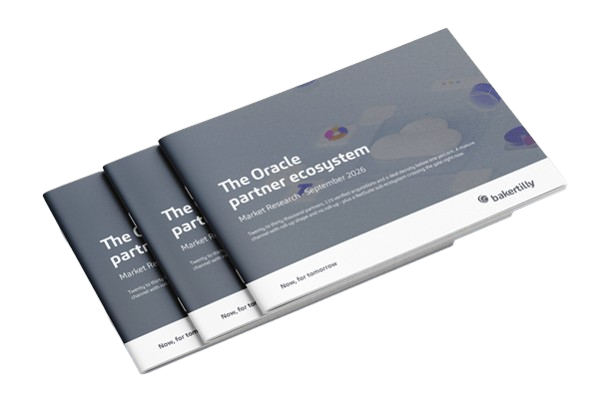
Oracle’s partner ecosystem comprises between 20,000 and 30,000 firms, but has recorded only 115 verified acquisitions over the past decade. This represents a consolidation rate of less than 1 per cent – the lowest among the mature enterprise software ecosystems we have analysed. Workday stands at 25 per cent and Microsoft Dynamics at 15 per cent. The report, compiled by our technology M&A advisers, covers companies, acquisitions and funding rounds within the Oracle channel, with data updated to September 2026.
Access the form to download the full report to find out about the state of the market, the most significant corporate transactions and the sector’s growth prospects.
Oracle’s partner market in 2026
An Oracle partner is an independent firm accredited by the manufacturer to resell, implement, integrate or manage its application solutions (ERP, HCM, SCM) and infrastructure (databases and Oracle Cloud Infrastructure). It is a mature ecosystem with the least consolidated channel: a large and fragmented market in which no buyer is grouping firms together on a large scale.
| Indicator | Data (September 2026) |
|---|---|
| Oracle Partners (estimated tier) | 20.000–30.000 |
| Verified acquisitions over a ten-year period | 115 |
| Compaction density | < 1 per cent |
| Density in Workday / Microsoft Dynamics | 25 % / 15 % |
| SAP (mature benchmark) | 369 transactions involving approximately 24,000 partners |
| NetSuite partners (sub-ecosystem) | 800–1.000 |
| NetSuite Operations (since 2022) | 29 (18) |
| Licence resellers | 0.5–1.1x revenue · 7.8–10.7x EBITDA |
| Implantation specialists | > 2.2x revenue · 16–25x EBITDA |
What is included in the Oracle Partner Marketplace?
The unit of analysis is the partner firm, not Oracle or the end customer. Licence and cloud usage revenue are excluded from the scope.
Oracle’s partner figures cover a broad spectrum for two reasons. They include both service firms and resellers, and the company does not publish a figure for service providers alone. In terms of size, this figure is comparable to SAP’s approximately 24,000 registered partners, but not to Salesforce’s 3,400 consultancy partners.
NetSuite is treated separately throughout the analysis. It operates four proprietary partner programmes, its own tiered structure and a distinct customer base. We cover this in detail in the NetSuite Partner Market Report 2026.
Six trends that are redefining the Oracle partner market
Method of consolidation without a consolidating entity
With 115 businesses and a market share of less than 1 per cent, the Oracle channel has the typical structure of a market ready for consolidation: mature, broad and fragmented. However, we have not identified any platform that is consolidating it. In the case of SAP, Dynamics and Salesforce, private equity firms filled that gap years ago.
Two businesses under the same licence
Oracle accreditation brings together two business models with very different valuations:
- Intensive licence resellers, which compete in terms of scale, range of manufacturers and compliance. They are valued at between 0.5 and 1.1 times revenue and between 7.8 and 10.7 times EBITDA.
- Value-added implementation specialists, valued at over 2.2 times revenue and between 16 and 25 times EBITDA.
The manufacturer does not distinguish between the two profiles in its figures. Therefore, segmenting them is the first task in the due diligence process.
NetSuite is crossing the threshold right now
The NetSuite sub-ecosystem comprises between 800 and 1,000 partners and 29 verified transactions, representing a density of approximately 4 per cent. Of these transactions, 18 have been completed since 2022, at a rate of four to five per year, compared with a previous maximum of three. It is a different market, with different buyers and a recommended timeline that is the opposite of that for the Oracle applications channel.
An unexpected buyer in the mid-market
In the Oracle applications channel, the buyers are large system integrators and cloud platforms. At NetSuite, by contrast, the buyers are finance and accountancy firms with close ties to the manufacturer, such as Cooper Parry and Zone & Co, which acquire the ERP solution most closely aligned with their core business. The rationale is strategic, not financial, and this changes what a seller must optimise before entering the market.
Oracle, a designated critical supplier under DORA
On 18 November 2025, the European Supervisory Authorities (EBA, EIOPA and ESMA) included Oracle amongst the 19 critical third-party ICT providers designated under the DORA Regulation, alongside AWS, Microsoft, Google and SAP. For a partner providing managed services on Oracle infrastructure, the provider itself sets the price for the product, certification and computing capacity. DORA has been fully applicable since 17 January 2025, with no transition period, and places critical providers under the direct supervision of the European authorities.
The longest value chain in the study
In an ERP project, consultancy, implementation, integration and operation each represent a substantial undertaking in their own right. Consequently, a partner’s position in the value chain determines its margin:
- La Resale is on a pass-through basis and generates little profit.
- La Implementation is the area most affected by artificial intelligence.
- Los Recurring services (support, application management and managed services) are what determine the exit multiple.
M&A consolidation within Oracle’s partner channel
115 verified transactions out of 20,000–30,000 partners equates to a density of less than 1 per cent, the lowest of any mature ecosystem in the dataset. SAP, which is also a mature ecosystem, records 369 transactions out of around 24,000 partners. Part of the difference is down to the definition, as Oracle’s figure includes resellers; the rest is a genuine gap.
The result is that the two sub-markets require opposite strategies:
- Oracle Applications is an opportunity to build. With a density of less than 1 per cent, there is no shortage of properties and hardly any competition amongst buyers. A seller entering the market today will have to educate their buyer. The advice is to build first and sell later.
- NetSuite is an instant-sale marketplace. With 18 of its 29 trades having been closed since 2022 and a group of buyers already active, the recommendation is to sell whilst the opportunity lasts.
Benchmark transactions and valuation multiples for Oracle partners
Comparable transactions
Prices for transactions between Oracle partners are rarely published, so most figures come from adjacent ecosystems:
| Buyer | Target | Valuation reference | Reading for an Oracle partner |
|---|---|---|---|
| EQT and GIC | Perficient | ~18.5x EBITDA (estimated) | Multi-platform scaling integrator |
| KKR | Fuji Soft (excluded from the stock market) | ~24.4x EBITDA (estimated) | Well above the median of 11.5x paid by funds |
| TCS | Coastal Cloud | $700 million | Major systems integrator acquiring specialist expertise |
| Accenture | Keepler Data Tech | 16.3x EBITDA (based on comparable data) | Data capabilities drive up the multiple |
| CDW | Sirius Computer Solutions | $2,500 M | Exit route from the resale layer |
Multiples by partner type
An Oracle partner’s valuation multiple depends on its revenue mix, not on its accreditation. A value-added reseller is valued at around 7.8 times EBITDA. Data and analytics capabilities can reach up to 16.3 times. Implementation specialists offering recurring services are valued at between 16 and 25 times EBITDA. If you’d like to find out how this applies to your situation, please consult our business valuation service.
Oracle Partner Market Forecast
The two sub-markets must be analysed separately, as they differ in terms of maturity, density and buyer profile:
- Oracle Applications Channel: between 20,000 and 30,000 partners, with less than 1 per cent acquired. It is a mature market undergoing consolidation, with no identified consolidator.
- NetSuite channel: between 800 and 1,000 partners, a density of 4 per cent and a rate of four to five transactions a year from 2022 onwards.
- ERP for SMEs: Annual growth of 11–12 per cent. Around half of NetSuite’s new customers sign up through a partner.
- Data and analytics insights: up to 16.3 times EBITDA, compared with 7.8 times for value-added resellers.
What does an Oracle partner mean for founders and buyers?
If you are the founder of an Oracle application partnerIf you are the founder of an Oracle application partner, the market today does not reward haste. Value is built by shifting the revenue mix away from resale and implementation towards recurring services, data and application management. The Ready4Exit method is designed to prepare the company for this future.
If you are a founder of a NetSuite partner, the window of opportunity is open. The buyer pool is active and strategic, so it is advisable to proceed with a well-structured competitive process. Our sale of businesses team supports this process from start to finish.
Whether you are a buyer or a fund, the Oracle channel offers a buy-and-build opportunity with little competition. The key lies in targeting resellers and specialists during due diligence. We help you identify and execute acquisitions through our Acquiring companies, and structure the financing through our service of search for investors and capital raising.
If your company is an Oracle partner and you’d like to find out how much it’s worth in today’s market, let’s have a chat.
Market Research
Market Research on NetSuite’s Partner Sector in 2026
Download the full report here and stay informed about the financial status and latest news of the most important companies in the market.
Frequently asked questions about M&A amongst Oracle partners
Oracle has between 20,000 and 30,000 partners, according to the Baker Tilly Tech M&A report updated in September 2026. This is a broad range because the vendor does not distinguish between service firms and resellers. In terms of size, this is comparable to SAP’s approximately 24,000 registered partners. NetSuite is analysed separately: its sub-ecosystem comprises between 800 and 1,000 partners, with its own programmes, tiers and buyers.
There have been 115 acquisitions of Oracle partners over the last decade, representing a consolidation rate of less than 1 per cent. This is the lowest figure amongst mature enterprise software ecosystems: Workday stands at 25 per cent, Microsoft Dynamics at 15 per cent, and SAP has recorded 369 transactions. Within the NetSuite sub-ecosystem, 29 transactions have been completed, 18 of them since 2022.
It depends on the sub-market. In Oracle applications, a density of less than 1 per cent indicates low competitive pressure amongst buyers, so the recommendation is to build value before selling, particularly by increasing the proportion of recurring revenue. In NetSuite, the opposite is true: with four to five transactions a year since 2022 and active strategic buyers, now is a good time to sell.
The value of an Oracle partner depends on its revenue mix. Licence-intensive resellers are valued at between 0.5 and 1.1 times revenue and between 7.8 and 10.7 times EBITDA. Value-added implementation specialists exceed 2.2 times revenue and are valued at between 16 and 25 times EBITDA. Data and analytics capabilities can reach 16.3 times EBITDA.
Since November 2025, Oracle has been one of the 19 critical third-party ICT providers designated under DORA by the European supervisory authorities, alongside AWS, Microsoft, Google and SAP. For a partner providing managed services on Oracle infrastructure, this means greater demands on resilience and compliance from its financial sector clients, and greater reliance on a single provider that sets product prices, certification requirements and computing resources.