
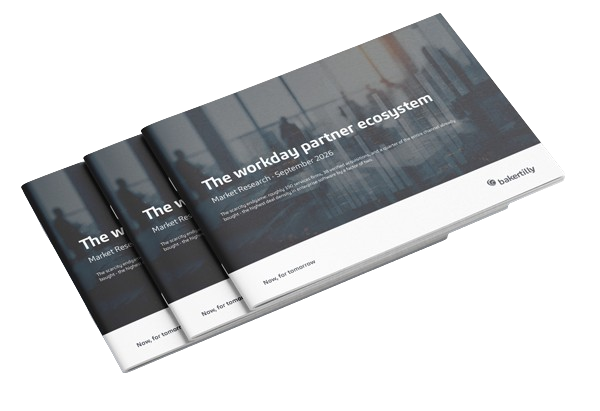
Workday’s partner market comprises around 150 accredited service firms, 38 of which have already been acquired. This means that a quarter of the channel has changed hands, representing the highest rate of consolidation of all the enterprise software ecosystems analysed by Baker Tilly Tech M&A. The report, compiled by our technology M&A advisers, sets out data on companies, acquisitions and funding rounds within the ecosystem, updated to September 2026.
Workday Partner Market in 2026
Workday es la cloud-based human capital management (HCM) and finance platform used by large organisations to manage human resources, payroll and accounting. Its partners are the certified consultancy firms and system integrators that deploy the platform, integrate it with other systems and operate it on behalf of the end client.
The key figures for the channel as at September 2026 are as follows:
| Indicator | Data |
|---|---|
| Accredited service providers | ~150 |
| Verified purchases | 38 |
| Compaction density | 25 per cent of the channel |
| Density in Microsoft Dynamics (comparison) | ~15 % |
| Total operations in the study dataset | 1.364 |
| Recurring revenue multiple | 6x–8x EBITDA |
| Revenue multiple per project | 3,5x–5x EBITDA |
For the owner of a Workday partner, this is the most favourable seller’s market in the enterprise software sector. For a buyer, it is the channel in which it is most difficult to grow organically.
What's Included in the Workday Partner Market
The unit of analysis is the partner firm. Neither Workday nor the end customer are included in the study, and subscription revenue from the platform is excluded from the scope.
The figure of around 150 firms includes only service providers, excluding resellers, registrars and marketplace listings that would inflate the denominator. That is why the density of 25 per cent is a reliable figure, whereas in ecosystems such as AWS, such a calculation is not possible. Workday is the clearest example from the study of how a small, well-refined denominator provides more information than a large, imprecise one.
Six trends that are redefining the Workday partner market
The shortage of accredited partners is coming to an end
There are around 150 accredited service providers and 38 verified acquisitions have been completed, meaning that a quarter of the channel has already changed hands. This is the highest density in the dataset: almost double that of Microsoft Dynamics (~15 per cent) and around 300 times that of AWS. The data suggests that a shortage of Workday partners is no longer merely a hypothesis. It has become the market’s key variable.
A shrinking partner base
In the ecosystem’s maturity phase, the number of independent firms falls by between 3 per cent and 6 per cent annually in the low-scenario. Consolidation is driving firms out of the market faster than such a tightly controlled partner programme is bringing new ones in. With a quarter of the channel already acquired, the remaining independent firms are few in number and are also dwindling, meaning that the shortage is building up rather than being resolved.
Workday manages the size of its channel
Workday has more power over its partners than any other vendor in the study because it decides how many there are. Its highly restrictive accreditation process is what has limited the total number to around 150 firms. This restriction gives each partner the ability to set prices and, at the same time, serves as the vendor’s leverage over all of them.
Migration costs comparable only to those of an ERP system
Workday’s client uses its human resources and finance modules as record-keeping systems. In human capital management, the risk is particularly personal: a failed payroll run or a botched benefits migration is visible to the entire workforce. That is why certified expertise commands a premium more reliably in Workday than in other enterprise software ecosystems.
The deployment portfolio is a finite resource
Each client is on-boarded only once, and the number of clients is finite. What distinguishes a Workday project portfolio practice from an annuity are application management services (AMS), payroll operations and productised version management tools. This difference is reflected in the valuation: recurring revenue trades at between 6 and 8 times EBITDA, whilst project-based revenue trades at between 3.5 and 5 times.
When it comes to recurring revenue, here’s a guide on how to increase the value of your business.
A value chain without a resale layer
The process involves seven stages, from subscription to the client’s end result, and there is virtually no resale layer in that chain: Workday’s partner business model is based on end-to-end services. This eliminates the low-margin pass-through segment typical of hyperscale and ERP channels. The trade-off is that it concentrates the business on the two stages most exposed to artificial intelligence, namely deployment configuration and testing.
M&A consolidation within Workday’s partner channel
The 38 verified transactions involving some 150 service providers represent a density of 25 per cent, the highest of the 1,364 transactions covered by the study. This is the key finding of the report because it sends the same message to both buyers and sellers: acquiring companies is the only way to enter this sector, and there are few companies left to acquire.
The competitive landscape is defined by who already holds accreditation, not by who might eventually obtain it. The major global integrators maintain the highest standard in Workday alongside the other vendor programmes, whilst the remaining independent players form a small group that any buyer in the sector can name. There is no long queue or information asymmetry to exploit. This transparency favours the seller, because all buyers recognise the same scarcity.
Workday partners’ benchmark transactions and valuation multiples
Comparable transactions
The prices of acquisitions by Workday partners are rarely published. The most useful references come from ecosystems with equally scarce accreditation, primarily Salesforce and ServiceNow partners:
| Buyer | Target | Ecosystem | Amount | Valuation reference |
|---|---|---|---|---|
| TCS | Coastal Cloud | Salesforce | $700 million | ~5x revenue; over 400 professionals and more than 3,000 certifications |
| Cognizant | Thirdera | ServiceNow | ~430 million (figure not officially disclosed) | The closest structural analogue to a Workday partner |
| ASGN | GlideFast | ServiceNow | $350 million | Around $95 million in sales (~3.7 times revenue) |
| KKR | Fuji Soft | IT Services (Japan) | — | ~24.4x estimated EBITDA (excluding stock market) |
Multiples per link in the value chain
In a market comprising 150 firms, with a quarter already well-established, sector averages represent a floor rather than an expectation, because the scarcity of accreditation has a direct impact on price.
| Link | Reference multiple | Reading |
|---|---|---|
| Deployment and configuration | 10.7x EBITDA / 1.1x revenue | Systems integration sector; the area most vulnerable to automation |
| Data migration and integration | 16,3x EBITDA | Upper limit of the value chain |
| Application management and execution | 8.9x EBITDA, up to 11.2x on a scale basis | Recurring revenue with a volume-based premium |
| Production-ready testing and version management | Software multiple | It is easily turned into a product and covers the entire range of services |
Workday partner market forecast
Over the coming years, the number of independent Workday partners is set to continue falling by between 3 per cent and 6 per cent annually under the low-case scenario. Workday’s accreditation programme is limiting new entrants, whilst consolidation continues to drive firms out of the market. The likely outcome is a channel that is increasingly concentrated amongst large integrators, with fewer independent partners available and upward pressure on the prices of those that remain.
What does a Workday partner mean for founders and buyers?
For the founder of a Workday partner, the report’s recommendation is to sell whilst capitalising on the shortage and, before doing so, to increase the proportion of recurring revenue (AMS, payroll operations, version management). This shift could raise the valuation from 3.5–5x to 6–8x EBITDA. A Ready4Exit method enables you to optimise this revenue mix before going to market, and our business valuation team can position the company against the sector’s benchmark multiples.
For a buyer, Workday accreditation can only be obtained by purchasing it, and the remaining independent providers are few in number and well known. Acquiring companies through this channel requires identifying targets before the competition does and structuring the transaction swiftly.
As technology M&A advisers, at Baker Tilly Tech M&A we support both the sale of businesses and the search for investors and capital raising within enterprise software ecosystems. If your company is a Workday partner and you’d like to find out what it’s worth in today’s market, let’s have a chat.
Market Research
Market Research on Workday’s partner sector in 2026
Download the full report here and stay informed about the financial status and latest news of the most important companies in the market.
Frequently asked questions about M&A amongst Workday partners
There are around 150 service providers accredited as Workday partners, according to the Baker Tilly Tech M&A report updated in September 2026. This figure includes only service providers, excluding resellers and marketplace listings. It is a small channel because Workday restricts its accreditation programme, and as the market matures, the number of independent firms falls by between 3 per cent and 6 per cent annually.
Thirty-eight acquisitions of Workday partners have been verified out of a total of around 150 accredited firms. Consequently, 25 per cent of the channel has already changed hands, representing the highest rate of consolidation of all the enterprise software ecosystems analysed by Baker Tilly Tech M&A across a total of 1,364 transactions. In Microsoft Dynamics, this proportion stands at around 15 per cent.
Yes. The Workday channel is the most favourable sales market for enterprise software. Accreditation can only be obtained by acquiring a firm that already holds it; there are few independent firms left, and all buyers are aware of this. The report recommends selling whilst capitalising on this scarcity and, beforehand, increasing the proportion of recurring revenue to achieve multiples of 6 to 8 times EBITDA.
It depends on the revenue mix. Recurring revenue (application management, payroll operations) is valued at between 6 and 8 times EBITDA, compared with 3.5 to 5 times revenue from project-based work. By service line, deployment trades at around 10.7x EBITDA, data migration and integration at up to 16.3x, and application management from 8.9x. In such a limited market, these averages act as a floor.
AI is putting particular pressure on deployment configuration and testing – the two areas on which a Workday partner’s business is focused – because its value chain does not include a resale layer. Deployment is the area most vulnerable to automation. By contrast, testing and the management of production versions can be turned into software and achieve higher multiples than any service.