
Google Cloud Partner Marketplace in 2026
The Google Cloud partner ecosystem comprises some 120,000 partners. Among these firms, the report identifies 55 verified acquisitions. This represents a consolidation rate of around 2 per cent of the services channel. It is a restricted-access ecosystem, in which certified capacity is growing faster than the number of firms. The data is current as of September 2026.
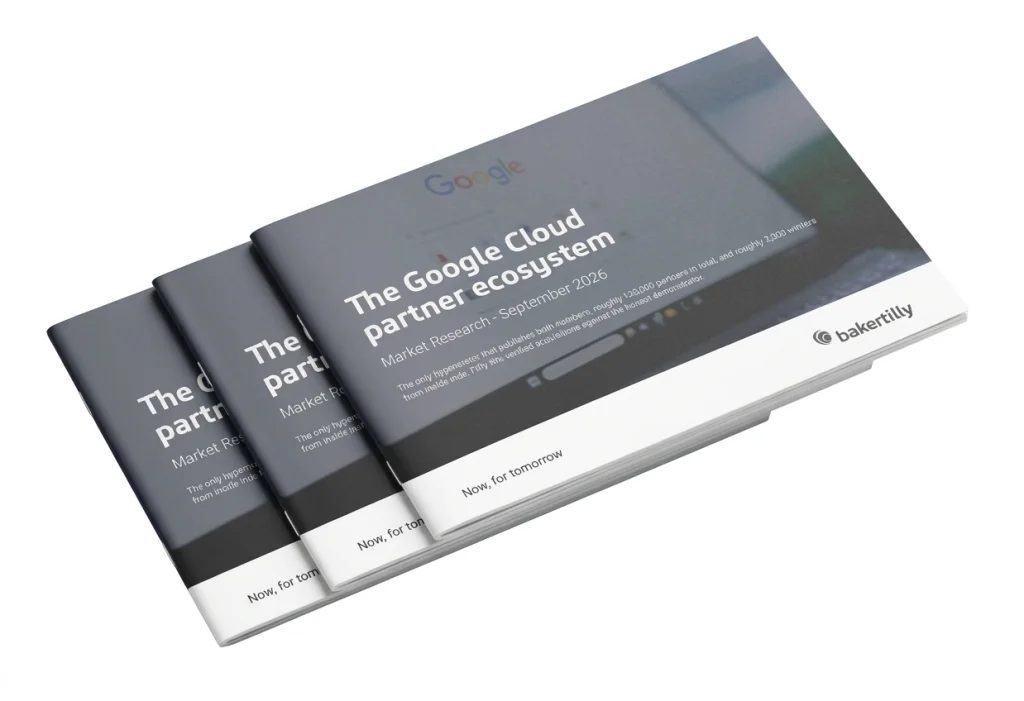
The report has been compiled by Baker Tilly’s team of technology M&A advisers who specialise in the sale and acquisition of technology companies. It provides an overview of the Google Cloud partner market, featuring data on companies, acquisitions and funding rounds within the channel.
| Indicator | Data |
|---|---|
| Partners in the ecosystem | ~120,000 (December 2025) |
| Service providers | ~2.900 |
| Verified purchases | 55 |
| Consolidation density (regarding service providers) | ~2 % |
| Ratio of total partners to service firms | ~41 to 1 |
| Stage of the ecosystem cycle | Restricted access |
| Google Cloud Marketplace Commission | 3 per cent (previously 20 per cent) |
| Medium-sized cloud service provider | 8.1x EBITDA |
| Data and analytics suite | 16,3x EBITDA |
What is included in the Google Cloud Partner Marketplace?
Google Cloud partners are consultancies, system integrators, resellers and managed service providers. Their role involves deploying, migrating, operating and optimising the platform for the end customer. This report takes the partner firm as its unit of analysis, rather than Google or the end customer. Revenue from platform usage is excluded from the scope.
This ecosystem calls for a methodological note that no other hyperscaler requires. Google discloses both the total number of partners and the subset of service providers. Consequently, the ratio between these two figures is clear: it stands at around 41 to 1. This is the best available illustration of just how much a hyperscaler’s headline figure exaggerates its actual capacity to deliver services. Consequently, this analysis measures consolidation across the ~2,900 service providers rather than across the total of 120,000.
Six trends that are redefining the Google Cloud partner market
Google Cloud is the only hyperscale provider to publish both figures
As of December 2025, Google Cloud had around 120,000 partners, of which approximately 2,900 were service providers. This disclosure turns a meaningless figure into a meaningful benchmark. With regard to service firms, the 55 verified acquisitions represent around 2 per cent of the channel. Based on the figure of 120,000, the same calculation would yield 0.05 per cent – a figure of no significance.
The transactional layer has lost its value
Google has reduced the commission on its marketplace from 20 per cent to 3 per cent, bringing it into line with Microsoft. Meanwhile, the transaction volume on hyperscale marketplaces is projected to reach $85 billion in 2028 and $163 billion in 2030. The traditional resale margin, which ranges from 15 per cent to 25 per cent, now competes with a 3 per cent listing fee. As a result, partners are shifting from being registered resellers to acting as advisers.
The real value lies in the data, not in the cloud logo
Cloud services, as a sub-sector, are trading at a median of 8.1x EBITDA, just above the floor set by resellers (7.8x). By contrast, data and analytics stand at 16.3x and cybersecurity at 16.1x. For a Google Cloud partner, this range is particularly advantageous, as the platform’s strengths lie in data and artificial intelligence. The highest-paying adjacent sector identified in the study is also the most natural extension of their work.
Cost governance functions as a perpetual annuity
On a pay-as-you-go platform, cost variances, changes to pricing models and rising expenditure recur every month. That is why ongoing optimisation contracts function as a natural annuity. A partner with FinOps capabilities retains revenue that a migration specialist cannot sustain. The proportion of recurring revenue is the first metric to be verified during due diligence.
Five branches of a single provider
A Google Cloud partner relies on Google in five key areas:
- Product: the platform on which it provides its services.
- Certification: the credentials that grant you access to the channel.
- Joint sale: the co-sell channel with Google’s sales team.
- Marketplace channels: the channel through which an increasing proportion of its turnover is generated.
- Computing capacity: In any managed service, the underlying infrastructure is a cost of sales.
Furthermore, Google has its own professional services division, which competes with the channel for major accounts. In November 2025, it was designated as one of the 19 Critical Third-Party ICT Providers under the European DORA regulation.
Capacity is growing faster than the number of firms
In a restricted-access ecosystem, certification thresholds rise and the number of firms remains roughly stable. The scarce resource is certified individuals, not logos. Corporate activity within the channel has already begun, but it has not yet driven out the independent operators.
M&A consolidation within the Google Cloud partner channel
The 55 verified transactions represent an average figure for the area. Their significance depends entirely on the denominator against which they are viewed. Divided by the figure of 120,000, they suggest an intact channel. Divided by the ~2,900 service providers, they represent around 2 per cent. This is half the density of ServiceNow and an order of magnitude higher than the AWS aggregate suggests. It is the most defensible hyperscale density figure in the study.
For reference, in other ecosystems analysed by Baker Tilly, density varies considerably. In the Workday partner market, a quarter of the firms have already changed hands. In the Freshworks market, there have not yet been any confirmed acquisitions.
Benchmark transactions and valuation multiples for Google Cloud partners
Comparable transactions
The price benchmarks that define the logic behind this channel are investments in data and artificial intelligence.
| Buyer | Target | Profile | Amount or multiple |
|---|---|---|---|
| Accenture | Keepler Data Tech (Spain, 2026) | Cloud-native data engineering | Undisclosed |
| Accenture | RANGR Data | Data | Undisclosed |
| Accenture | Faculty (United Kingdom) | Applied AI and proprietary decision intelligence product; over 400 employees | ~$1,000 M |
| CDW | Sirius Computer Solutions | Infrastructure and resale | $2,500 M |
| H.I.G. Capital | Converge Technology Solutions | Infrastructure; delisting and merger with Mainline in Pellera | ~$1,000 M |
| EQT and GIC | Perficient | Digital services | ~18.5x EBITDA (estimated) |
La Accenture’s acquisition of the Spanish firm Keepler is the deal that defines this sector: the 16.3x multiple was acquired rather than built up. At the infrastructure level, the CDW–Sirius deal illustrates the path out of the resale layer.
Multiples per link in the value chain
| Link | EV/EBITDA multiple | Reading |
|---|---|---|
| Resale | 7,8x | Value chain floor |
| Cloud services | 8.1x (median) | The low end of the range, as long as the revenue mix remains unchanged |
| Cybersecurity, FinOps, optimisation and compliance | 16,1x | Reduced exposure to AI compression |
| Data engineering and analytics | 16,3x | Studio ceiling and centre of gravity of the Google product |
Google Cloud Partner Market Forecast
The channel’s growth stems from two trends: revenue is shifting along the value chain, and volume is migrating towards the marketplaces of hyperscale companies.
- Trading volume on marketplaces: around 85,000 million dollars in 2028 and 163,000 million in 2030, across the hyperscale sector as a whole.
- Cloud services as a sub-sector: a median of 8.1x EBITDA, at the lower end of the range as long as the revenue mix remains unchanged.
- Data engineering and analytics: a ceiling of 16.3x EBITDA, which coincides with the platform’s product centre of gravity.
- FinOps, optimisation and compliance: 16.1x EBITDA within the cybersecurity sector, with the lowest exposure to pressure from artificial intelligence.
What does a Google Cloud partner mean for founders and buyers?
For founders: The recommended approach is to take your time, but to build the foundation first. With a density of around 2 per cent, there is no sense of urgency forcing you to launch a process. What creates value is incorporating data engineering, FinOps and a managed consumption model before going to market. A partner that moves beyond reselling or migration towards data and recurring optimisation can shift from an 8x to a 16x EBITDA multiple. It is this groundwork that forms the basis of the Ready4Exit methodIt begins with a business valuation that separates recurring revenue from project-based revenue.
For buyers: The scarce asset is certified personnel, not firms. When Acquiring companies in this sector, due diligence must first verify the proportion of recurring revenue. It must then assess exposure to Google’s five business units, including competition from its professional services in key accounts.
Market Research
Market Research on Google Cloud’s partner sector
Download the full report containing details of companies, acquisitions and funding rounds within the Google Cloud partner ecosystem, updated as of September 2026.
Frequently asked questions about M&A amongst Google Cloud partners
Google Cloud had around 120,000 partners in December 2025, of which approximately 2,900 are service firms. It is the only hyperscaler to publish both figures, and the ratio between them is around 41 to 1. When analysing M&A, the relevant denominator is the ~2,900 service firms, because the aggregate figure includes partners with no actual delivery capacity.
Baker Tilly has identified 55 acquisitions of Google Cloud partners up to September 2026. Out of the approximately 2,900 service firms, this represents a consolidation rate of around 2 per cent. This is half the rate seen at ServiceNow and significantly lower than the 25 per cent seen in the Workday channel. Corporate activity has already begun, but it has not yet displaced independent partners.
There is no rush to sell. With a consolidation rate of around 2 per cent, there is no sense of urgency that would force a company to initiate a sale process. Baker Tilly’s recommendation is to take your time, but to build up your business first. This means incorporating data engineering, FinOps and recurring revenue from managed services before going to market, because these capabilities are what drive up the valuation multiple.
It depends on their revenue mix. Cloud services are valued at a median of 8.1x EBITDA, just above resellers (7.8x). Partners specialising in data engineering and analytics reach 16.3x. FinOps, optimisation and compliance fall within the cybersecurity bracket, at 16.1x. As pricing benchmarks, Accenture paid around $1 billion for Faculty, whilst EQT and GIC acquired Perficient at an estimated 18.5x EBITDA.
Artificial intelligence affects each link in the channel differently. For data partners, it is a bonus: AI is one of Google Cloud’s strengths, and data engineering is the best-paid adjacent sector in the study (16.3x EBITDA). By contrast, FinOps, optimisation and compliance services are the least exposed to margin compression caused by AI. Accenture’s acquisitions of Keepler and Faculty confirm this interest in data and AI capabilities.