
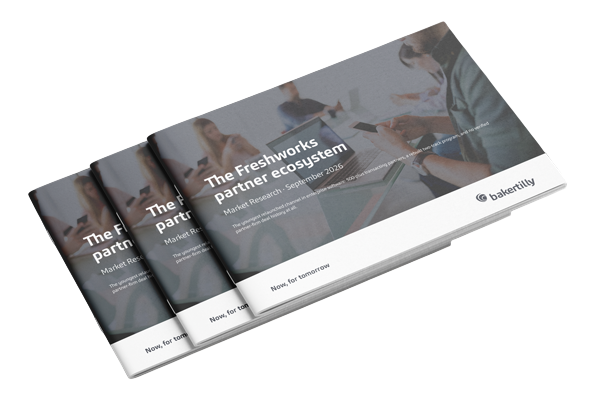
The Freshworks partner marketplace brings together more than 500 firms that have completed transactions. It is a channel in a phase of rapid growth: the number of firms is increasing, certification makes little difference, and there is still no buyer that has built a platform. The report, compiled by our advisers specialising in the sale and acquisition of technology companies, sets out data on companies, acquisitions and funding rounds within the ecosystem, updated as of September 2026.
Freshworks’ Partner Market in 2026
Freshworks is a provider of cloud-based software for customer service, IT service management and CRM, with products such as Freshdesk, Freshservice and Freshsales. Its partners are resellers, consultancy firms and system integrators who sell its licences, implement them and integrate them with the customer’s other systems.
The key figures for the channel as at September 2026 are as follows:
| Indicator | Data |
|---|---|
| Partners involved in a transaction | Over 500 (April 2025) |
| Verified purchases from partners | 0 |
| Stage of the ecosystem cycle | Crowd |
| Growth in the number of firms | A high digit |
| Total operations in the study dataset | 1,364 (in 12 ecosystems with verified counts) |
| Resale multiple for licences | 0.5x revenue / 7.8x EBITDA |
| Cap on service costs (integration and data) | 16,3x EBITDA |
For the owner of a Freshworks partner, there is not yet an established buyer’s market. For a buyer, it is one of the few channels where the benchmark price can still be set.
What is included in the Freshworks Partner Marketplace?
The unit of analysis is the partner firm. Neither Freshworks nor the end customer are included in the study, and the manufacturer’s subscription revenue falls outside the scope.
The figure of over 500 refers only to partners that have carried out transactions, not to firms that have simply registered with the programme. This is a stricter measure than that used by other ecosystems: SAP’s approximately 24,000 partners include free registrations, and Snowflake’s figure of over 14,000 is reduced to a few hundred service providers once duplicates have been removed.
Six trends that are redefining the Freshworks partner market
A relaunched channel in its crowd-sourcing phase
In April 2025, Freshworks revamped its partner programme with expanded reseller and service channels, and reported more than 500 active partners. The structure accommodates authorised resellers, premier resellers, service providers and system integrators. Being in a growth phase means that joining remains straightforward, the number of partners is growing and certification requirements are not particularly stringent. Consequently, the scarcity driving M&A in other channels does not yet apply here.
One of the few channels whose partner base is growing
The number of partners is determined by the phase of the ecosystem’s cycle, not by the manufacturer’s revenue. Open and multi-vendor ecosystems are gaining new partners, whilst mature ecosystems are losing them due to consolidation. Freshworks is in the expanding group, alongside Anthropic, Snowflake and Databricks, with high single-digit growth in the number of partners. Revenue from services attributed to the channel is growing at a mid-to-high single-digit rate.
The revenue mix is the only distinguishing factor
In a crowded ecosystem, certification does not set one firm apart from another. What distinguishes a Freshworks premium partner from an undifferentiated one is the revenue mix and geographical reach. A licence reseller for small and medium-sized enterprises is valued at the lower end of the range, at 0.5 times revenue and 7.8 times EBITDA. A services firm with recurring revenue, vertical specialisation or data capabilities can reach 16.3 times EBITDA.
Price-sensitive customers with low switching costs
Freshworks sells to small and medium-sized enterprises and the mid-market – customers whom large enterprise platforms struggle to reach effectively. These customers are price-sensitive, switch providers easily and pay little attention to the partner’s standing. What they are looking for is a fixed, predictable price, rapid deployment and a single point of contact. It is a different product from that which comes with top-tier accreditation in Salesforce or Workday.
A channel shaped by geography
Freshworks relies on local resellers to support its expansion in Asia and Latin America. This geographical focus influences the valuation. The study’s median enterprise value-to-EBITDA ratios are 11.2x in Asia, 10.9x in North America, 10.0x in Europe and 8.3x in the rest of the world. Emerging-market firms are valued at a discount due to the lower availability of capital and the risk associated with scaling up, and this directly affects a significant proportion of Freshworks’ reseller base.
Greater room for negotiation with the manufacturer
In a crowded ecosystem, partners negotiate from a stronger position than usual. Freshworks continues to supply the software, for which there is no substitute, but is recruiting partners rather than restricting them. This gives partners a degree of financial leverage that they are unlikely to have again once the channel matures. The real constraint lies in their own cost base, which depends on the geography of delivery and the cost of labour.
Adquisiciones de partners de Freshworks
Of the twelve ecosystems with a verified count of transactions within the study’s total of 1,364 transactions, Freshworks is the only one with none. This is not a low figure; it is a complete absence of transactions, and is consistent with its stage in the cycle. M&A amongst partners begins when the manufacturer restricts access and intensifies as the ecosystem matures. In the crowding-out phase, there is nothing scarce enough to bid for.
The result is that there are no established buyers in this channel. None of the five types of buyer identified in the study has set up a Freshworks partner platform. The first to make a move will set the benchmark price and will have to prove the case on their own.
Key steps for evaluating a Freshworks partner
Comparable transactions in other ecosystems
As there are no in-house operations, the most useful benchmarks are the first acquisitions in the newer sectors, such as those involving OpenAI and Anthropic, and major deals in mature ecosystems:
| Buyer | Target | Ecosystem | Date | Reading |
|---|---|---|---|---|
| Ode (backed by Anthropic) | Casper Studios | Anthropic | August 2026 | A team of 41 people; first-stage operation |
| AlixPartners | Artium | OpenAI and Anthropic | August 2026 | Around 80 employees; the organisation’s main asset was its accreditation status, not its workforce |
| Cognizant | Thirdera | ServiceNow | 2023 | ~$430 million (estimated; figure not officially disclosed); reference to the mature end |
Multiples per link in the value chain
The value chain for a Freshworks partner is short, and most of the channel is at its lowest-value link. The opportunity for a business owner lies in the gap between their current position and the upper tiers:
| Link | Reference multiple | Reading |
|---|---|---|
| Resale of licences to SMEs | 0.5x revenue / 7.8x EBITDA | Where most of the channel is today; it competes with marketplace commissions of between 1.5 per cent and 3 per cent |
| Deployment and configuration | 10.7x EBITDA / 1.1x revenue | Small, repeatable projects are the most likely to be automated |
| Integration and data | Up to 16.3x EBITDA | The ceiling on services; the range from 0.5 times revenue represents the full scope for value creation |
| Productised intellectual property and accelerators | Software multiple | It outperforms the entire table; it is the only stock on the secondary market in a sector where certification does not command a premium |
Freshworks Partner Market Forecast
The number of Freshworks partners will continue to grow at a high single-digit rate whilst the manufacturer keeps the programme open. In the medium term, the likely scenario is that seen in other ecosystems that have already gone through this phase. Once the channel has stabilised, the first acquirer will build a platform, and consolidation will begin with firms that have recurring revenue, integration capabilities, and their own data or intellectual property. Firms focused on reselling licences will continue to be valued at rock-bottom levels.
What does a Freshworks partner mean for founders and buyers?
For the founder of a Freshworks partner, the report’s recommendation is that they should take action. The risk is not that the market will collapse, but that its structure will change: if the early buyers build the first platform, the independent players who have held out will end up selling to a single buyer, with no competitive pressure. Before that happens, it is advisable to shift the resale mix towards recurring services, integration and data, or proprietary accelerators. A Ready4Exit process allows this mix to be organised before entering the market, and our team can position the company in line with the sector’s benchmark multiples.
For a buyer, Freshworks is a channel with no benchmark price and no competition for assets. Acquiring companies within this ecosystem allows buyers to get in ahead of the rest and select targets with the best revenue mix.
As technology M&A advisers, at Baker Tilly Tech M&A we support companies through the sale of businesses within the enterprise softwareecosystem. If your company is a Freshworks partner and you’d like to find out what it’s worth today, let’s have a chat.
Market Research
Market Research on Freshworks’ partner sector
Download the full report containing details of companies, acquisitions and funding rounds within the Freshworks partner ecosystem, updated as at September 2026.
Frequently asked questions about M&A amongst Freshworks partners
Freshworks has more than 500 active partners, according to the figure it announced when it relaunched its programme in April 2025. It only counts firms that are actually selling products or providing services, not those that have registered but are inactive. The channel continues to grow at a high single-digit rate in terms of the number of firms, as the programme is in its expansion phase and it is easy to join.
There have been no verified acquisitions of Freshworks partners. It is the only one of the twelve ecosystems with verified figures from the Baker Tilly Tech M&A study – covering 1,364 transactions – that has recorded none. This absence is consistent with its stage in the cycle: M&A amongst partners begins when access to the channel becomes restricted, and at Freshworks, certification does not yet lead to a shortage.
It depends on the revenue mix. A licence reseller for SMEs is valued at around 0.5 times revenue and 7.8 times EBITDA. Implementation and configuration stand at 10.7 times EBITDA, whilst integration and data reach 16.3 times. Productised intellectual property commands software multiples. Geography also plays a role: the median is 11.2x EBITDA in Asia and 10.0x in Europe.
There is still time, but it is advisable to take action. At present, there is no established buyer, so the price has not yet been set. The risk is that the first buyers will create a platform, and those who wait will end up selling to a single buyer with no competition. The report recommends making the most of this window of opportunity to move from resale to recurring services, integration or in-house accelerators.
Hardly. In a crowded ecosystem, certification makes no difference, and Freshworks’ customers – SMEs and mid-market organisations – pay almost no attention to a partner’s tier. What drives valuation is the type of revenue: recurring revenue, vertical specialisation, integration and data capabilities, and productised intellectual property. This is the opposite of what happens in restricted channels such as Workday.