

By 2026, the Open Source Software (OSS) services market in Europe will have firmly established itself as the de facto standard infrastructure for the cloud, artificial intelligence and public administration, having evolved from a technical alternative. According to the latest report from Baker Tilly Tech M&A Advisors, with data updated to January 2026, the adoption of Kubernetes in production rose from 66 per cent to 82 per cent between 2023 and 2025, whilst cumulative funding for the sector over the last decade now exceeds $50.1 billion.
Three figures sum up the scale of the change: Kubernetes adoption in production now stands at 82 per cent of companies; the OSS sector raised $2,360 million in funding up to September 2025 (+118 per cent year-on-year); and the benchmark multiples for high-quality mid-market operators range between 10x and 12x EBITDA.
The European OSS services market encompasses consultancy, integration and the operation of open infrastructures
The OSS services market encompasses consultancy, implementation, integration, support and managed operations for open-source technologies: from cloud-native infrastructure (Kubernetes, containers), Linux operating systems and data platforms, to CMS, ERP, DevOps and artificial intelligence infrastructure.
This analysis excludes the direct sale of licences by software manufacturers themselves (Red Hat, SUSE, Canonical, etc.) and the adjacent markets for traditional proprietary software development. The focus is on system integrators and consultancy firms that provide services to businesses and public administrations using open technology stacks, a segment with its own M&A dynamics that differ from those of the manufacturers.
Six trends that are revolutionising the OSS services market in Europe
The combination of regulatory pressure, price disruption in the virtualisation market and the rise of open AI is redefining which assets are attractive to strategic or financial buyers. These are the six trends shaping the sector in 2025–2026.
Cloud-native and Kubernetes are establishing themselves as a universal infrastructure
The adoption of Kubernetes in production has risen from 66% to 82% between 2023 and 2025. The CNCF (Cloud Native Computing Foundation) now hosts more than 230 projects and 300,000 contributors, an ecosystem whose operational complexity exceeds the in-house capacity of most organisations: 85 per cent of companies need external help to manage their containerised workloads.
This gap in in-house capability is the main driver of demand for managed services, and explains why Kubernetes-specialist integrators command a valuation premium over generalist providers.
European digital sovereignty is redefining public procurement
El 97 per cent of the cloud infrastructure used in Europe is controlled by non-European providers, a dependency that has prompted a decisive political response. In January 2026, the European Parliament voted, by 471 votes to 68, in favour of an ‘Open Source first’ approach to public procurement, with the aim of achieving 70 per cent open-source components by 2030 and establishing a Sovereign Technology Fund worth 10,000 million euros.
For OSS integrators with exposure to the public sector, this policy provides a sustained regulatory tailwind for demand for their services.
VMware’s price disruption acts as a catalyst for migration
The price increases imposed by Broadcom following its acquisition of VMware – ranging from 800 per cent to 1,500 per cent depending on the customer – are driving companies towards open-source alternatives for virtualisation. Red Hat reported growth of over $300 million in its virtualisation pipeline in the first three quarters of 2025 alone.
This wave of forced migration represents one of the sector’s most obvious and quantifiable business opportunities for the coming financial years.
AI infrastructure is built on open source
The market for open-source AI models reached $13.4 billion in 2024, with a projected figure of $54.7 billion by 2034. Corporate spending on generative AI increased 3.2-fold in 2025, reaching $37 billion, and tools such as PyTorch and vLLM have become de facto standards for model deployment.
Integrators capable of combining expertise in Kubernetes with AI infrastructure (MLOps, model orchestration, GPU-as-a-service) currently occupy the position offering the greatest added value within the OSS ecosystem.
Software supply chain security is gaining regulatory importance
The Cyber Resilience Act, which came into force in December 2024, will make it mandatory to report vulnerabilities from September 2026 onwards. Given that 76 per cent of enterprise software consists of open-source dependencies, SBOM (Software Bill of Materials) requirements are driving substantial and ongoing demand for regulatory compliance services.
This regulatory requirement makes supply chain security a stable line of business, which is less sensitive to the economic cycle than other integration services.
Supplier consolidation benefits multi-technology integrators
Managing between 20 and 30 different support contracts leads to operational fragmentation, which European organisations are actively addressing in 2026 by consolidating their supplier base. This trend favours multi-technology integrators over single-product specialists, who risk losing business when clients streamline their supplier portfolio.
M&A consolidation is reshaping the European OSS services market
M&A activity in the OSS ecosystem has been characterised by large-scale deals in the vendor segment: IBM’s acquisition of Red Hat (US$34,000 million, 2019, already written off against cumulative operating revenue), Broadcom’s purchase of VMware (US$61,000 million) —the main indirect catalyst for demand for open-source alternatives— and IBM’s acquisition of HashiCorp (US$6,400 million, 2025). EQT is also exploring a sale of SUSE for around US$6,000 million, almost doubling its valuation prior to delisting.
Meanwhile, total funding for the OSS sector reached $2.36 billion across 34 funding rounds up to September 2025, representing a year-on-year increase of 118 per cent, with cumulative funding over the last decade exceeding $50.1 billion.
The Eruopean OSS services market — as distinct from the manufacturers’ market — is characterised by extreme fragmentation: there is no dominant integrator, and regional specialists typically operate within a revenue range of 5 to 50 million dollars. This structure provides classic ground for private equity ‘buy-and-build’ strategies: a platform acquisition of an integrator with revenue of 5–15 million euros, followed by 3–5 complementary technological or geographical acquisitions, can create a regional champion with revenue of 30–50 million euros within 3–4 years. Benchmark multiples for the mid-market range from 10x and 12x EBITDA for high-quality operators, with additional premiums for recurring revenue from managed services, technological specialisation (Kubernetes, AI) and exposure to the public sector.
Spain, and in particular the Basque Country’s ecosystem, offers significant competitive advantages within this European landscape: lower labour costs than in the DACH region, a dense industrial fabric (Tecnalia, Vicomtech, the automotive cluster) and favourable legal frameworks such as Law 40/2015 on the reuse of software between public administrations. Regional consolidation (bolt-on) deals and strategic acquisitions by global IT firms seeking to strengthen their OSS capabilities in response to the public sector’s digital sovereignty requirements predominate.
For IT firms and funds seeking to grow through acquisitions in this fragmented landscape, having a structured acquisition process is key to identifying the right target and executing a ‘buy-and-build’strategy. And for OSS platforms that need capital to fund their consolidation, our seeking investors or raising capital service identifies the right financial or strategic partner.
Growth forecasts for the OSS services market in Europe up to 2035
According to consensus estimates from various sources, the global OSS services market is projected to be worth between 30,000 and 40,000 million dollars by 2025, with a compound annual growth rate (CAGR) of 15 per cent to 18 per cent through to the end of the decade. The European market is growing at a faster rate than this global average, and the segments requiring the highest level of technical specialisation — platform engineering and Kubernetes — are showing the highest growth rates across the entire ecosystem.
| Market | Period | Projected CAGR | Estimated development |
|---|---|---|---|
| OSS Services (Europe) | 2023-2030 | 17,4% | From $6,900 million to $21,100 million |
| Managed services (Global) | up to 2023 | 17,6% | Fastest-growing segment of the global market |
| Platform Engineering (Global) | 2025-2035 | 23,4% | From $5,760 million to $47,320 million |
| Kubernetes Solutions (Global) | 2025-2031 | — | From $2,570 million to $8,410 million |
The European OSS services market is set to triple in size between 2023 and 2030, outpacing global growth. Platform engineering is emerging as the most dynamic sub-segment, driven by the transition to recurring revenue models and the consolidation of Kubernetes as a universal control infrastructure for enterprise computing.
What does this consolidation mean for founders and investors in OSS services?
For the founders and management teams of OSS integrators and consultancies, the current climate combines two key indicators: strong investor appetite from private equity platforms ‘buy-and-build’, and increasingly stringent valuation criteria focused on recurring revenue, technological specialisation (Kubernetes, AI) and exposure to the public sector. Preparing for a sale in advance – by organising financial information and documenting recurring contracts – makes the difference between a successful transaction and a missed opportunity.
For the investors and strategic buyers, the European OSS services market continues to offer an attractive deal flow due to its extreme fragmentation: there is no dominant integrator, which opens up opportunities for well-executed regional consolidation strategies. Our Market Intel service enables you to identify and evaluate targets using up-to-date industry data.
At Baker Tilly Tech M&A Advisors, we support both companies looking to sell their tech business and investors seeking to grow through acquisitions, backed by a track record of over 260 completed transactions in the tech sector.
Next steps for your OSS services company
The European OSS services market has evolved from a technical niche to become a strategic asset within the portfolios of private equity firms and major IT companies. Consolidation will continue to accelerate in the coming years, driven by digital sovereignty, price disruption in virtualisation and the advancement of open AI infrastructure.
If you’re part of an OSS services company and want to understand where your company stands on this map – whether to prepare for a sale, seek an investor or explore acquisitions – let’s have a chat.
Market Research
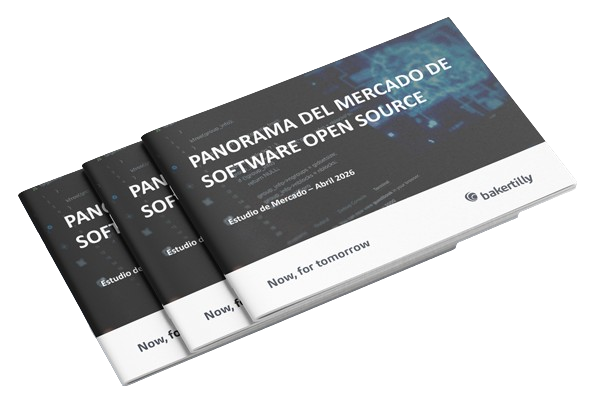
Market Research on the Open-Source Software Sector in Europe
Download the full report here and stay informed about the financial status and latest news of the most important companies in the market.
Frequently asked questions about the OSS services market in Europe
Open-source software (OSS) services include consultancy, implementation, integration, support and managed operations for open technologies: cloud-native infrastructure, Kubernetes, Linux systems, data platforms, CMS, ERP, DevOps and AI infrastructure. This excludes the direct sale of licences by manufacturers such as Red Hat or SUSE, and the development of traditional proprietary software.
Investor appetite is high, particularly for integrators with recurring revenue, specialisation in Kubernetes or AI, and exposure to the public sector. Mid-market multiples stand at between 10x and 12x EBITDA for high-quality operators. The extreme fragmentation of the European market also favours targets with a distinctive position as ‘buy-and-build’.
Several factors are coming together: Broadcom’s price hike following its acquisition of VMware is driving the shift towards open-source alternatives; the European Parliament has voted in favour of an ‘open-source first’ approach to public procurement; and funding for the sector grew by 118 per cent year-on-year up to September 2025. The fragmentation of the systems integrators’ market – with no dominant player in Europe – also creates classic conditions for consolidation through private equity.
Key factors include the proportion of recurring revenue from managed services, technological specialisation in Kubernetes or AI infrastructure, exposure to public sector contracts in the context of European digital sovereignty, and diversification of the client portfolio. Multi-technology integrators tend to secure better terms than single-product specialists, particularly in light of the supplier consolidation currently being undertaken by European organisations.
Preparation involves organising financial information, documenting recurring and supporting contracts, formalising intellectual property rights over in-house developments or integrations, and reducing reliance on individual technical experts. A preliminary assessment with an adviser specialising in technology M&A helps to identify and address these issues before the process begins.