
ServiceNow’s partner market in 2026
The ServiceNow partner market is undergoing significant consolidation. There have been 97 verified acquisitions of partner firms – representing around 4 per cent of the channel – at a double-digit annual rate since 2020. The ecosystem now comprises over 2,700 partners following the 2026 programme overhaul, but only six firms hold Global Elite status. The platform is growing at over 20 per cent annually, whilst the number of certified professionals within the channel is not keeping pace. As a result, buyers are paying premiums for certified teams rather than building them from scratch.
This report, compiled by our advisers specialising in the sale and acquisition of technology companies, compiles data on companies, acquisitions and funding rounds within the ecosystem, updated as of September 2026. The unit of analysis is the partner firm, not ServiceNow or the end customer, and the platform’s subscription revenue is excluded from the scope.
What is a ServiceNow partner and how is the ecosystem structured?
A ServiceNow partner is a firm that resells, implements, integrates or operates the ServiceNow platform for end customers, as part of the manufacturer’s partner programme. The size of the ecosystem depends on how it is measured, and there are two figures in circulation that measure different things:
- Between 1,300 and 2,200 consultancy and implementation firms, based exclusively on services. This figure is comparable to Salesforce’s 3,400 consultancy partners and Workday’s 150 service firms.
- More than 2,700 partners, based on the full programme following the 2026 reform. This is not comparable with the six-figure figures of the hyperscalers.
From 2026, the programme will be organised into a five-tier structure: Registered, Select, Premier, Elite and Global Elite. The tier is what the end customer regards as a sign of the partner’s legitimacy, and what a buyer examines first during due diligence.
6 trends that are transforming the ServiceNow partner market
The manufacturer’s tier policy as a driver of consolidation
In April 2026, ServiceNow consolidated all its programmes into five tiers and scrapped the 37-area points system, under which virtually all partners had reached the top. The company froze the current status and granted 18 months to meet more stringent thresholds for certified staff and performance. Every rationalisation of this kind reduces the number of firms at the top of the programme and exacerbates the shortage that leads to buying capacity rather than building it.
Staff certified as a scarce resource
In a restricted-access ecosystem such as ServiceNow’s, capacity is growing faster than the number of firms. Thresholds are rising whilst the partner base remains flat, meaning that certified individuals – rather than logos – are the scarce resource. The platform is growing by over 20 per cent annually, and talent within the channel cannot keep pace; this is why buyers pay premiums for certified teams rather than recruiting them.
The ServiceNow takeover is trading at a premium, not a discount
In IT services, reliance on a single vendor negatively affects valuation: between 0.5 and 1 point in the multiple above 25–30 per cent exposure, and 1 to 2 points above 35 per cent. With ServiceNow, the rule is reversed. The buyer is specifically acquiring the certified stack, not a diversified portfolio, so a pure-play Elite-level firm is valued higher than a comparable-sized multi-platform generalist.
A fragmented base beneath a narrow apex
Approximately half of ServiceNow’s consultancy partners employ fewer than 100 people, and some 300 boutique firms with fewer than 50 employees joined the programme in a single financial year. At the other end of the spectrum, only six firms hold Global Elite status, and Accenture alone reports more than 23,000 certifications. Capacity is concentrated amongst the large integrators, whilst the broader base offers a wide range of acquisition targets.
ServiceNow as a provider, guardian and stakeholder in the channel
ServiceNow provides its partners with the product, certification, joint sales channel and the level of credibility that customers perceive, and unilaterally amended all four in 2026. Furthermore, it co-invests in the channel through Ecosystem Ventures, alongside Keensight in Plat4mation and Capital Square in InMorphis. This makes the manufacturer a shareholder in firms for which a buyer may be bidding.
Artificial intelligence reduces the cost of implementation
Implementation is the link in the ServiceNow value chain most exposed to automation. The median valuation multiple for private IT services transactions fell to 8.8 times EBITDA by the end of 2025, down from 13.6 times in 2023. Firms that avoided this downward revaluation shifted towards managed services and intellectual property, where recurring revenue is valued at approximately twice that of project-based revenue.
ServiceNow partner acquisitions: who is buying and at what price
There have been 97 verified acquisitions of ServiceNow partner firms, representing approximately 4 per cent of the channel, with a peak of 14 transactions in both 2021 and 2024. This paints a picture of a channel where consolidation is underway, but independent firms have not yet been completely phased out.
| Ecosystem | Firms acquired through the channel |
|---|---|
| Workday | 25 % |
| Microsoft Dynamics | 15 % |
| ServiceNow | ≈4 % |
| SAP | 1,5 % |
| AWS | < 1 % |
ServiceNow has the most developed buyer base of all the service channels analysed. Fund-backed platforms compete directly with strategic buyers for the same certified vendors:
- Private equity platforms: NewRocket, under Gryphon, completed five deals in less than three years. A newer generation of companies is continuing to take shape: CoreX under NewSpring, Plat4mation under Keensight and InMorphis under Capital Square.
- Strategic buyers: Cognizant and DXC have each completed six transactions within the ServiceNow family.
| Operation | Year | Amount | Reference |
|---|---|---|---|
| Cognizant acquires Thirdera | 2024 (closing date) | ≈USD 430 million | The largest independent pure-play partner in the ecosystem |
| ASGN acquires GlideFast | 2022 | ≈USD 350 million | ≈95 million USD in turnover and ≈350 consultants (≈3.7x turnover) |
| ServiceNow acquires Moveworks | 2025 | USD 2,850 million | Native AI capabilities that partners are no longer charging for |
Sources: Cognizant’s annual report and ASGN press release.
The strategy available to a consolidator is clear: to invest at 5–8 times EBITDA in specialist firms with EBITDA of less than 3 million and integrate them into platforms valued at between 10 and 14 times EBITDA.
Valuation multiples by stage in the ServiceNow value chain
ServiceNow’s channel growth stems from revenue per client and the redistribution of that revenue across the value chain, rather than from the addition of new clients. Each link in the chain is valued differently:
| Link | EV/EBITDA multiple | EV/Sales multiple | Exposure to disruption |
|---|---|---|---|
| Resale of a licence | 7.8x (lower limit of the range) | 0,5x | Registration, through disintermediation |
| Deployment and configuration | ≈10,7x | 1,1x | maximum, through AI-driven automation |
| Integration, data and cybersecurity | 16.1x–16.3x (top end of the range) | — | — |
| Managed services and application deployment | ≈10.7x, rising to 11.2x above 500 million US dollars | — | The lowest in the chain |
Implementation accounts for the largest share of the channel’s turnover and, at the same time, the greatest exposure to automation. Integration, data and cybersecurity represent the upper end of the chain, at approximately twice the size of the systems integration segment. For a partner firm, the breakdown of its revenue by segment influences both its valuation and its size.
What does this mean for a ServiceNow partner considering selling
Understanding the market means capitalising on scarcity by selling, having first identified the most likely buyers. For the founder of a ServiceNow consultancy, this translates into four specific strategies:
- Programme tier. The 18-month timeframe for the new thresholds means that Elite or Premier tier status becomes a time-limited benefit if it is not maintained.
- Certified workforce. This is what the buyer is acquiring. Its size, retention rates and reliance on key personnel are directly factored into the price.
- Revenue mix. Shifting revenue from implementation towards managed services, integration or intellectual property improves the multiple.
- The buyer landscape. Private equity firms, global integrators and ServiceNow’s own investment ecosystem each have their own rationale, and it is worth understanding these before launching a process.
At Baker Tilly, we support founders of technology companies through the sale of their business and the preparatory work leading up to it via Ready4Exit. We also advise buyers seeking targets within the ecosystem through our service of Acquiring companies.
Market Research
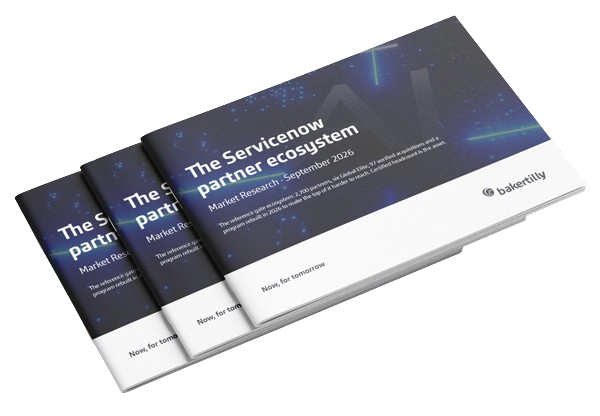
Market Research on ServiceNow’s partner sector in 2026
Download the full report here and stay informed about the financial status and latest news of the most important companies in the market.
Frequently asked questions about M&A amongst ServiceNow partners
ServiceNow has more than 2,700 partners when the full programme is taken into account following the 2026 reform. If only consultancy and implementation firms are counted, the figure stands at between 1,300 and 2,200, comparable to Salesforce’s 3,400 consultancy partners and Workday’s 150 service firms. Only six partners hold the highest tier, Global Elite, and approximately half of the consultancy partners have fewer than 100 employees.
There are two types of buyer competing. On the one hand, there are platforms backed by private equity funds, such as NewRocket (Gryphon), CoreX (NewSpring), Plat4mation (Keensight) and InMorphis (Capital Square). On the other, strategic integrators such as Cognizant and DXC, each with six acquisitions within the ecosystem. Notable acquisitions include Cognizant’s purchase of Thirdera for around $430 million and ASGN’s acquisition of GlideFast for around $350 million.
It depends primarily on the size and revenue mix. Specialised firms with an EBITDA of less than 3 million are acquired at between 5 and 8 times EBITDA, whilst established platforms are valued at between 10 and 14 times. By segment, implementation stands at around 10.7 times EBITDA, whilst integration, data and cybersecurity reach 16.1–16.3 times, and the resale of licences remains at the lower end of the scale, at around 7.8 times.
In 2026, ServiceNow replaced a 37-tier points system with a five-tier ladder: Registered, Select, Premier, Elite and Global Elite. It froze the current status and gave partners 18 months to meet more stringent thresholds for certified staff and performance. Partners who fail to meet these thresholds will be downgraded, which narrows the programme’s top tier and encourages them to purchase certified capacity rather than build it in-house.
Current conditions favour the seller: the platform is growing at over 20 per cent a year, there is a shortage of certified talent, and both private equity funds and strategic integrators are competing for the same teams. Furthermore, the focus on ServiceNow is commanding a premium. It is advisable to prepare for the sale in advance by consolidating the company’s position within the programme and its certified workforce, and by identifying the most likely buyers before initiating the process.