
Databricks’ partner market in 2026
The Databricks partner market commands the highest-paying work in the technology services sector, but has yet to begin to consolidate. Data and analytics consultancies are valued at a median of 16.3 times EBITDA, higher than cybersecurity (16.1 times) and roughly double that of systems integration. Even so, of the 1,364 transactions analysed in the study, none involved a Databricks partner. The channel is currently in a phase of oversupply: entry is straightforward, certifications offer little differentiation, and a buyer can acquire premium capabilities without paying a scarcity premium.
This report, compiled by our advisers specialising in the sale and acquisition of technology companies, compiles data on companies, acquisitions and funding rounds within the ecosystem, updated as at September 2026. The unit of analysis is the partner firm, not Databricks or the end customer, and revenue from platform usage is excluded from the scope.
What is a Databricks partner, and what stage is the ecosystem at?
A Databricks partner is a services firm that designs, builds and operates data and artificial intelligence platforms on Databricks for end customers, covering data engineering, analytics, governance and model deployment. It is the ecosystem responsible for preparing the data on which enterprise AI will operate.
Partner ecosystems go through a life cycle, and the phase they are in determines the acquisition strategy. Databricks is in the ‘crowd’ phase:
- A simple entry. The number of firms is growing at a high single-digit rate, whilst mature ecosystems are losing between 3 per cent and 6 per cent of their partners each year.
- Certifications that lack discriminatory power. The programme’s current structure does not yet distinguish between partners with genuine capacity and those who are merely registered.
- No shortage clock. There is no small pool of reputable firms for buyers to bid on, as is the case with ServiceNow or Workday.
Databricks shares this growing segment with Snowflake, Freshworks and Anthropic. The ecosystem does not have a verifiable count of partners, so the report does not calculate a transaction density ratio. This is a deliberate omission: inventing a denominator to obtain a percentage is precisely the error that the methodology seeks to avoid.
6 trends that are transforming the Databricks partner market
Premium work with low barriers to entry
Data and analytics consultancies are trading at a median of 16.3 times EBITDA, the highest multiple amongst the technology services analysed. However, the Databricks partner programme remains in a ‘crowded’ phase, with low barriers to entry and certifications that offer little differentiation. The result is an exploitable anomaly: a buyer can acquire firms that perform the best-paid work identified in the study without paying a scarcity premium. That window will close as soon as Databricks tightens the requirements of its partner programme.
The widest range of ratings in the entire study
The data and analytics sub-sector has a first quartile of 10.7 times EBITDA and a third quartile of 27.1 times, centred around a median of 16.3. Two firms that nominally do the same work can be valued at a difference of two and a half times. What sets them apart is not Databricks certification, but three variables:
- Proprietary intellectual property (accelerators, sector-specific data models, product).
- Proportion of recurring revenue.
- Vertical depth in specific sectors.
A target population that is growing rather than shrinking
In mature ecosystems, every acquisition reduces the pool of independent players. At Databricks, the opposite is true: the direction of growth depends on the phase of the ecosystem, not on the vendor’s revenue, and open ecosystems are adding companies at high single-digit rates. For a consolidator, this means more candidates each year and more time to build a platform.
Agent-based AI requires governed data
Gartner predicts that up to 40 per cent of enterprise applications will integrate specialised AI agents by the end of 2026, compared with less than 5 per cent in 2025. No agent can be deployed reliably on ungoverned data, so every agent-based project first requires a well-organised, traceable and compliant database. This is the sector’s most powerful driver of demand and falls directly on the shoulders of data platform partners such as Databricks.
Talent: the constraint that limits growth
Skills in data engineering and artificial intelligence are the main drivers pushing salaries above the rate of inflation. At the same time, the recruitment of junior staff in India’s IT sector has fallen from around 380,000 to around 120,000 per year, which is shrinking the talent pool on which much of offshore delivery relied. That is why the operations offering the highest returns in this sector are those centred on talent: bringing nearshore or offshore delivery centres in-house and building training capacity to develop a talent pool in the sector’s most scarce skill areas.
Data services are more effective than implementation
An implementation comes to an end; a data platform does not. Schema changes, new data sources, model retraining and audit requirements recur every month. A data partner converts project revenue into recurring revenue more easily than an ERP or service management implementer, and that difference pays off: recurring revenue is valued at between 6 and 8 times EBITDA, compared with between 3.5 and 5 times for project revenue.
Acquisitions within the Databricks partner ecosystem
Of the 1,364 transactions covered by the study, twelve ecosystems have recorded verified transactions, whilst Databricks has recorded none. This is consistent with the ‘crowd’ phase, but it is striking: the capacity offered by these partners is precisely what the sector’s most active firms are purchasing.
Accenture is the clearest example. In recent months, it has purchased data and AI capabilities rather than building them in-house:
| Operation | Date | Profile | Amount |
|---|---|---|---|
| Accenture acquires Keepler Data Tech | April 2026 | A Madrid-based cloud-native data engineering and AI company with over 240 professionals | Unpublished |
| Accenture acquires RANGR Data | November 2025 | A Palantir-certified partner, with around 40 specialists | Unpublished |
| Accenture acquires Faculty | Announced in January 2026, closing in March 2026 | Applied AI and our own decision intelligence platform, with over 400 professionals | ≈USD 1 billion (according to press reports) |
Sources: Accenture on Keepler, RANGR Data press release and Ffromculty.
The acquisition of Keepler is particularly significant for the Spanish market: it confirms that a global integrator is willing to pay for local data engineering teams. What has not yet happened is for such acquisitions to be structured around Databricks certification.
In terms of notable deals in the technology services sector, Cognizant paid around $430 million for Thirdera, whilst EQT acquired Perficient for around $3,000 million.
Valuation multiples by stage in the Databricks value chain
The value chain of the Databricks ecosystem is short and positioned at the top. The dominant links are those which, in other ecosystems, constitute a premium adjacent market, rather than the core business:
| Link | EV/EBITDA multiple | Exposure to automation |
|---|---|---|
| Data engineering and analytics | 16.3x (third quartile 27.1x) | Core and ceiling of the chain |
| Governance, traceability and compliance | 16.1x (cybersecurity sector) | Low |
| Pipeline construction billed by the hour | 10.7x (1.1x sales) | Maximum. First candidate for a downward revision |
The path to growth is shaped by agent-driven demand: if 40 per cent of enterprise applications incorporate specialised agents, each one will require governed data before it can be deployed. For a partner firm, shifting revenue from hourly-based pipelines towards governance, managed services and intellectual property carries significant weight in its valuation and its size.
What does this mean for a Databricks partner considering selling
The report’s recommendation is clear: there is still time, but it is advisable to take action. A property owner in a phase of high demand is not under time pressure, and any buyer will need the ecosystem explained to them. The risk is not cyclical but structural: if the first consolidators build the first platform, the independent operators who held out will end up selling into a market lacking competitive pressure.
For the founder of a Databricks consultancy, this translates into four key drivers:
- Intellectual property. Accelerators, sector-specific data models and in-house products are what distinguish the first quartile (10.7x) from the third (27.1x).
- Recurring income. Turning projects into managed platform services boosts revenue from 3.5–5x to 6–8x EBITDA.
- Vertical specialisation. In-depth knowledge of specific sectors carries more weight than certification.
- Team and talent pipeline. In a market where there is a shortage of talent in data and AI, the stability of the team and the ability to develop new talent are directly reflected in the price.
At Baker Tilly, we support founders of technology companies through the sale of their business and the preparatory work leading up to it via Ready4Exit. We also advise buyers who wish to build a platform within the ecosystem through our company acquisition service.
Market Research
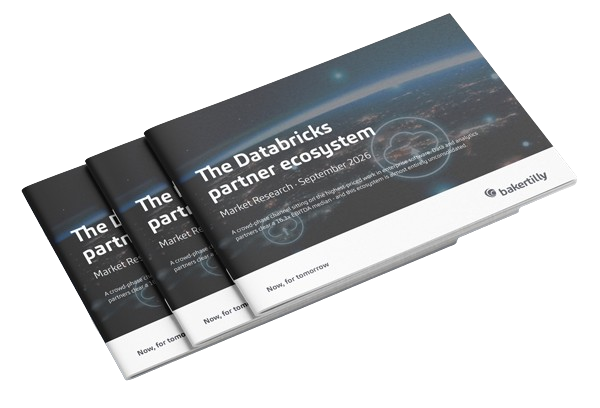
Market Research on Databricks’ partner sector in 2026
Download the full report here and stay informed about the financial status and latest news of the most important companies in the market.
Frequently asked questions about M&A amongst Databricks partners
Data and analytics consultancies are valued at a median of 16.3 times EBITDA, the highest multiple amongst the technology services analysed. The spread is enormous: the first quartile stands at 10.7 times and the third at 27.1 times. This difference is explained by proprietary intellectual property, the proportion of recurring revenue and sector-specific specialisation, not by Databricks certification. Hourly-billed projects sit at the lower end of the range.
Not yet in an organised manner. Of the 1,364 transactions analysed in the study, none involved a Databricks partner, which is consistent with an ecosystem in its early stages. However, buyers are indeed acquiring the same capabilities: Accenture has acquired the Spanish firm Keepler Data Tech, RANGR Data and Faculty, the latter for around $1 billion. These acquisitions have yet to be organised around Databricks accreditation.
The main driving force is agent-based AI. Gartner predicts that up to 40 per cent of business applications will incorporate specialised agents by the end of 2026, compared with less than 5 per cent in 2025. No agent can be guaranteed to function properly on disorganised or ungoverned data, so every project first requires a traceable and compliant database. This groundwork is precisely what data platform partners do.
Three factors carry more weight than size. The first is the proportion of recurring revenue, which is valued at between 6 and 8 times EBITDA, compared with between 3.5 and 5 times for project-based revenue. The second is intellectual property: accelerators, sector-specific data models or proprietary products. The third is vertical specialisation. The stability of the technical team also affects the price, as talent in data and AI is the scarcest resource in the sector.
There is no urgency, but there is a risk in waiting too long. The ecosystem is in a phase of abundance and there is as yet no premium for scarcity, so the seller will have to explain the market to potential buyers. The risk is structural: if the early consolidators build the first platform, independent players who wait to sell will find themselves in a market with no competition amongst buyers. It is advisable to prepare the business in advance and identify potential buyers.