
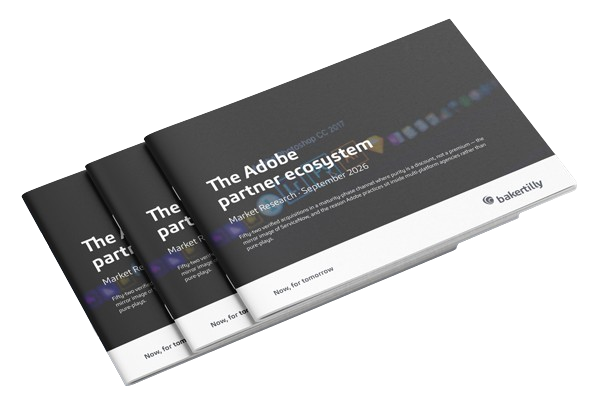
Adobe’s partner market is maturing. The number of independent agencies and consultancies is falling, and those that are being acquired are increasingly doing so as practice groups within multi-platform digital services platforms. The Baker Tilly Tech M&A report, with data updated to September 2026, tracks 52 verified acquisitions of partner firms. It puts the median valuation at between 6.7 times EBITDA for firms with an enterprise value of less than $5 million and 12.7 times times for those valued at over $500 million. The key conclusion runs counter to intuition: in the Adobe ecosystem, specialising in a single vendor detracts from value rather than adding to it.
Adobe Partner Sector Report 2026
The report analyses the agencies and consultancies that work with Adobe technology. The unit of analysis is the partner firm, not Adobe or the end customer; consequently, the manufacturer’s subscription revenue falls outside the scope of the report.
There is a methodological decision that warrants explanation. Adobe does not have a verifiable count of partners, so the 52 transactions are presented without a density ratio (transactions per hundred partners). Inventing a denominator to obtain a percentage is precisely the error that the methodology seeks to avoid. What can be established using the data, however, is the stage of the cycle at which the ecosystem finds itself and its pattern of concentration. Both of these factors determine how an Adobe asset should be valued in a process involving the acquisition and sale of technology companies.
What is the Adobe partner ecosystem?
Adobe’s partner ecosystem brings together agencies, consultancies and integrators who implement, integrate and operate Adobe technology for their clients. Their work ranges from implementing Adobe Experience Cloud to producing content at scale using creative tools.
It has two features that set it apart from other enterprise software ecosystems:
- The buyer is in marketing, not IT. Projects are commissioned by the marketing and digital department, which manages more discretionary and cyclical budgets.
- The value chain includes content production. Alongside consultancy, implementation, data integration and managed services, there is a creative production element that no other studio ecosystem offers.
5 trends in the Adobe partner market
Purity as a discount, not as a premium
Adobe is the counterexample to ServiceNow. At ServiceNow, focusing on a single vendor increases the multiple. At Adobe, it reduces it. The reason is structural: work on Experience Cloud coexists with content, commerce, data and creative operations within the same procurement centre. That is why firms with broad cross-platform capabilities come out on top. An Adobe capability is acquired as a practice within a broader digital services platform, not as a standalone asset.
Creative production versus engineering
Adobe’s partners are categorised along a spectrum that other ecosystems do not have. According to the report:
- The agencies with significant production output are valued at between 7.8 and 9.8 times EBITDA and have the highest exposure to generative artificial intelligence of any in the study.
- The leading engineering firms are trading at a digital engineering multiple of 12.1 times EBITDA.
- Those that have incorporated customer data are trading at up to 16.3 times EBITDA.
Generative AI is taking over production capacity
The content-generation capability built into the platform itself represents work that a production-focused partner is no longer able to bill for. Furthermore, this process progresses more quickly in creative tools than in management software (ERP). High-volume content production is the channel’s largest source of work and, at the same time, the activity most amenable to automation in the entire report. The economies of scale that define this ecosystem represent the market putting a price on that risk.
A procurement centre with discretionary funding
An Adobe partner’s client is the marketing department, not the IT department. Marketing budgets are more discretionary and cyclical, with shorter contracts and more frequent competitive reviews. That is why recurring revenue from managed services carries greater weight here than the headline multiples suggest. It distinguishes the firm that has to win back the business in every planning cycle from the one that does not.
The scale is worth six times the score
The median EV/EBITDA multiple rises from 6.7 times for enterprise values below US$5 million to 12.7 times for those above US$500 million. This represents a difference of around six points attributable solely to size, regardless of the mix of services. A boutique agency and a digital services platform are distinct assets, even if they both hold the same Adobe accreditation.
Valuation multiples for an Adobe partner
The value of an Adobe partner depends more on the nature of its business and its size than on the accreditation itself. These are the benchmark categories set out in the report:
| Firm type | EV/EBITDA multiple | A factor that explains it |
|---|---|---|
| An agency with a strong track record in production | 7,8x – 9,8x | Greater exposure to generative AI |
| A leading name in engineering | 12,1x | Platform roll-out |
| Integration and customer data | Up to 16.3x | Premium proximity to the ecosystem |
| A scalable cross-platform platform | ~18.5x (estimated) | Purchasing vehicle; Perficient reference |
The overall landscape of IT services has also changed. According to the report, the median multiple for private IT services transactions fell to 8.8 times EBITDA by the end of 2025, compared with 13.6 times in 2023. An Adobe partner seeking a valuation today is operating in a less favourable services market than three years ago. Therefore, before initiating a sale process, it is advisable to obtain an independent company valuation that positions the firm within the correct valuation range.
Acquisitions by Adobe’s partners and referral schemes
With 52 verified acquisitions of partner firms, Adobe ranks in the middle of the twelve ecosystems analysed in the study:
| Ecosystem | Tracked partner acquisitions |
|---|---|
| Google Cloud | 55 |
| Adobe | 52 |
| IBM | 46 |
| Workday | 38 |
| NetSuite | 29 |
What sets Adobe apart is not the volume, but the form. Assets change hands as practices within cross-platform digital services businesses, because that is how the concentration discount affects their valuation.
Perficient: a case study
In 2024, EQT delisted Perficient in a deal valued at around $3,000 million in enterprise value. The report estimates the multiple at 18.5 times EBITDA. Perficient is a large-scale, multi-platform asset that counts Adobe amongst its technology partners: the type of vehicle within which an Adobe practice is housed and sold.
Adjacent operations that determine the range
The following transactions are not acquisitions of Adobe partners. We have included them because they highlight the valuations and capabilities that buyers of digital services currently value:
| Operation | Buyer | Asset profile | Why it is a benchmark |
|---|---|---|---|
| Faculty (2026) | Accenture | AI implemented using in-house software; over 400 employees | Around $1,000 million for AI capacity (Consultancy.uk) |
| Keepler Data Tech (2026) | Accenture | Cloud-native data engineering; Spanish, over 240 professionals | It represents a data adjacency of 16.3x (Idealista/Europa Press) |
| Coastal Cloud (2025) | TCS | Partner Summit de Salesforce | 700 million dollars in cash for a multi-cloud partner (Consulting Magazine) |
| NeuraFlash | Accenture | AI consultancy for Salesforce offering managed services | Agent-based AI and recurrence premium |
| Fuji Soft (2025) | KKR | IT services listed in Japan | ~24.4x estimated EBITDA, compared with a median of 11.5x for the funds |
Keepler is the closest benchmark for the Spanish market. A digital experience practice that incorporates customer data engineering could move out of the production bands and approach the 16.3-times band.
How will Adobe’s partner market develop?
As the market matures, the number of independent firms declines. That is why the key consideration is not how many transactions there will be, but how much leeway a property owner has between valuation bands before selling:
- Agencies with a high proportion of production work (7.8x – 9.8x). These are the ones most exposed to generative AI. Their scope for improvement lies in reducing the proportion of production work in their turnover.
- Leading engineering firms (12.1x). This is the natural arena for a practice driven by platform implementation.
- Integration and customer data (up to 16.3x). This is the premium adjacency that an Adobe practice should aim for.
- Multi-platform scaling output (~18.5x). This is the platform through which an Adobe application is sold.
The levers are specific: increasing recurring revenue from managed services, incorporating customer data capabilities, and expanding the offering to other platforms within the same buying centre. Identifying and working on these before going to market is the aim of the Ready4Exit method. The report’s recommendation to owners is clear: sell, and sell on a large scale.
Advice on selling from an Adobe partner
The value of an Adobe partner depends on where it sits on the production–engineering–data spectrum, its size and the recurring nature of its revenue, rather than on its accreditation. If you run an Adobe agency or consultancy and are considering a transaction, Baker Tilly’s team of technology M&A advisers can help you prepare for the sale, estimate its value and identify buyers who will pay for the breadth of your offering.
Market Research
Market Research on Workday’s partner sector in 2026
Download the full report here and stay informed about the financial status and latest news of the most important companies in the market.
Frequently asked questions about M&A amongst Adobe partners
An Adobe partner agency is typically valued at between 6.7 and 12.7 times EBITDA, depending on its size. This is the range of median figures set out in the Baker Tilly Tech M&A report, covering firms with an enterprise value of less than $5 million up to those worth over $500 million. Within that range, the type of business activity influences the multiple: creative production agencies are valued at between 7.8 and 9.8 times, engineering agencies at around 12.1 times, and those specialising in customer data analysis reach 16.3 times.
Because at Adobe, specialisation in a single vendor acts as a discount rather than a premium. Unlike at ServiceNow, work on the Adobe Experience Cloud shares a budget with content, commerce, data and creative operations, all within the same marketing department. Buyers pay more for firms with broad cross-platform capabilities, which can cover the entire procurement function. An isolated Adobe capability is purchased as part of a larger platform, not as a standalone asset.
Adobe’s partners are primarily cross-platform digital service providers – often backed by private equity funds – and global integrators. A prime example is Perficient, which was taken private by EQT in 2024 for around $3 billion, at an estimated multiple of 18.5 times EBITDA. These buyers integrate the Adobe business into a broader offering of expertise, data and technology. That is why they place greater value on scale and recurring revenue than on certification.
Generative AI is reducing the value of partners specialising in content production. The generative capabilities built into Adobe’s tools now cover work that these agencies used to bill for, and are advancing more rapidly in creative tools than in management software. That is why agencies with a strong focus on production are valued at the lower end of the range, between 7.8 and 9.8 times EBITDA. Engineering and customer data firms are less exposed and are valued at between 12.1 and 16.3 times.
The Adobe ecosystem is maturing, with fewer and fewer independent firms and buyers prioritising cross-platform reach. The recommendation in the Baker Tilly Tech M&A report is to sell, and to do so with a comprehensive offering: recurring managed services, customer data and a presence across multiple platforms. Before selling, it is advisable to prepare the company to move from one valuation band to another, as the difference between the production band and the customer data band exceeds six times EBITDA.