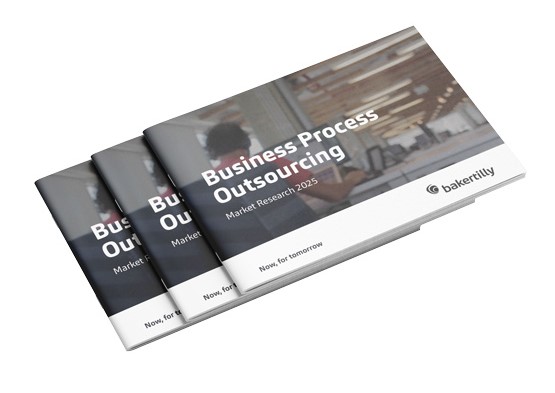
In a world where operational efficiency, scalability and digitalisation set the pace of competition, Business Process Outsourcing (BPO) has established itself as a a cornerstone for businesses looking to grow without increasing internal complexity. But the BPO sector is not what it was ten years ago: it is evolving at a rapid pace.
Baker Tilly’s Tech M&A team has published an exclusive report analysing the the current state and strategic opportunities of the BPO marketHere are some of the key trends highlighted in this study, and why you should download it.
Scalability and flexibility: the new standard in outsourcing
Traditional outsourcing is giving way to more agile and adaptable models. Companies are no longer looking solely for cost savings; they want partners who enable them to scale up (or down) quickly in response to market demand.
What does this mean for businesses?
- Customer service teams can scale up for a launch without compromising on quality
- It allows services to be adjusted in line with seasonal trends or unexpected events
- They could introduce less rigid contracts with modular structures
This point is explained in the report: the adoption of Flexible BPO models enable companies to reduce operating costs without compromising responsiveness, a key factor in volatile environments.
Green Outsourcing: sustainability as a competitive advantage
Sustainability is no longer an option: it is an expectation. And the BPO sector is no exception. Just as is the case in the film and television industry, Leading providers are incorporating environmentally responsible practices into their value proposition, from energy management in data centres to hiring remote staff to reduce their carbon footprint.
Why does it matter?
- Corporate clients are demanding ESG transparency across their entire supply chain
- Remote operations and centres nearshore help to reduce the logistical impact
- Sustainability boosts reputation and improves customer retention metrics
This information is set out in the report: the ‘green’ transition BPO not only meets an ethical requirement, but is also becoming a key selection criterion for long-term outsourcing contracts.
for long-term outsourcing contracts.
Gone are the days when BPO was seen simply as a collection of repetitive tasks outsourced to third parties. Today, the most competitive BPO firms utilise robotic process automation (RPA), advanced analytics platforms and artificial intelligence models to deliver not only efficiency but also valuable insights.
Examples of this revolution:
- Automation of tasks such as invoice validation, customer onboarding and document management
- Real-time sentiment analysis in customer service centres
- Predictive dashboards for SLA management and continuous improvement
Complementary platforms (RPA, AI, vertical SaaS) not only improve margins, but are also the new standard for standing out from traditional competitors.
Consolidation and M&A: the race to scale up and specialise
The report reveals a landscape of intense merger and acquisition (M&A) activity, with more than 170 transactions analysed between 2020 and 2023. The aim? To scale up, gain access to new markets, and acquire technological capabilities.
Key trends:
- Investors in private equity focusing on companies with revenues of $1 million to $50 million
- BPOs acquiring automation or artificial intelligence start-ups
- Consolidation in mature markets such as Spain, where the top five companies account for over 65% of the sector’s revenue
A point explained in the report: the multiples paid for BPO companies with a strong technological component exceed the average for Business Services, a clear indication that Specialisation and innovation are being rewarded.
Key figures confirming the rise of BPO
In addition to the trends, the report includes market data that reflects the sector’s strong growth:
- The global BPO market was valued at USD 280.6 billion in 2023 and is expected to reach between USD 490 billion and USD 603 billion for 2029–2032.
- Spain is set to grow by 3,37% CAGR until 2029, with a strong focus on multilingual services and cloud technology.
The subcategory of non-voice contact centres is growing by 6,9% CAGR, driven by demand in the telecommunications and media sectors.
Segmentation that enables bespoke solutions
The report also provides an in-depth analysis of the various types of outsourcing:
- Customer Experience (CX): the most established section, now digitised
- Finance & Accounting: outsourcing for compliance and standardisation
- Human Resources y Supply Chain: key services for multinational companies operating in complex regulatory environments
- IT-enabled services: from data entry to advanced analytics
Each of these segments presents different opportunities for both buyers and suppliers. A thorough understanding of them is key to making strategic decisions. If you are investor or advisor on M&A transactions, understand which types of BPO assets are currently in highest demand and why it is a clear competitive advantage.
And if you’re already operating in the BPO sector, the report offers insights on how to stand out, scale up and prepare for an environment where technology, sustainability and flexibility are no longer optional.
Would you like to know how these trends will affect your business? Are you exploring opportunities for consolidation, entering new markets or improving internal processes? Contact our advisors specialising in the sale and purchase of companies in the technology sector, they will help you turn these trends into strategic decisions.
BPO Industry Report 2025
Download here the complete report and stay informed about M&A activity and the latest news from the most important companies in the market.